 |
| A BBC Micro |
As a child, my first real exposure to computers was the
BBC Micro in school, which is probably true of many people my age who lived and went to school in the UK during the mid-to-late 80s and early 90s. I didn't learn a great deal on it, but I was interested. We had just the one in our primary school, and I got the chance to program in
Logo and dabble in BASIC a little. The main thing I can remember is using a Turtle to plot out our Logo commands onto a piece of paper, drawing numerous patterns. It was all very limited, but fun.
 |
| An Amstrad PCW 8256/8512 |
The next step was the
Amstrad PCW8256 (See more in
Writing and Publishing the 'Rebel Review'). My father bought this machine essentially for creating the local Parish Magazine, although he was also a bit of a gadget fan which I'm sure played a significant part. When he wasn't using it, my older sister Hilary and I were allowed to have fun trying different things. She was learning computing in secondary school while I was still in primary, so she was the most knowledgeable. Occasionally my father's '
8000 Plus' magazine (Later renamed 'PCW Plus') would contain 'listings' in the back pages. These were short programs that you could type in to the computer using the PCW's '
Mallard BASIC'. Whenever one popped up that was a game, my sister and I were soon busily typing away, inputting line after line of code onto the PCW's green-only screen. Hours would be spent sifting through the code, sometimes printing it out so we could compare it to the magazine listing, and highlight bits where we'd gone wrong. I also spent a fair amount of time creating graphics using the PCW version of Logo, and printing out the pictures.
 |
| Tomahawk on the Amstrad PCW |
Eventually we got a few games for the PCW, the main ones of which were
Fairlight,
Tau Ceti and
Tomahawk. Tomahawk was my first exposure to 3D gaming, and also prompted the purchase of a joystick. It was heralded as being incredibly realistic to the physics and mechanics of the real thing, with countless buttons on the keyboard used to control the various aspects of the helicopter. I spent a long time studying the manual and trying all sorts.
 |
| Fairlight on the Amstrad PCW |
Fairlight was the first isometric 3D game I had ever played, with a wonderful and utterly engrossing fantasy world full of unusual and exciting locations to explore and mysteries to solve. Tau Ceti was essentially a fun shoot-em-up, but again with a wide-ranging world to explore.
My most prominent use of the PCW was for my own magazine, the 'Rebel Review' which you can read about separately (
Click here). Eventually my father upgraded the machine with an extra 256k internally, a whopping 1MB ram-pack, a bubble-jet printer and a mouse, with which I was able to enjoy creating early monochrome pixel graphics with some desktop publishing software.
 |
| A ZX Spectrum 48k |
During this time, I also got a
Sinclair ZX Spectrum 48k, the very first computer of my own. Well known for its small size and rubber keyboard. To this day it's still a design classic, in my opinion. Admittedly, I fell into the trap that many did, of using it to play only games. When I needed to write a document or print anything, I still used my father's PCW. One thing the Spectrum did do, was encourage my early tinkering. Once or twice I had problems with something, or a friend's machine went wrong, and I was able to swap chips around on the inside, changing those from a couple of dud machines in to the damaged one and vice-versa, till I could get one working. I even still have a 48k Spectrum that stopped working, but after my experimental repair work functions fully, but only in B&W! Later I moved onto the
Spectrum+2, with its 128k memory and built in tape-loader, enabling me to play the newer, larger games with better sound.
 |
| Issue 1 of 'Your Sinclair' |
No discussion of the ZX Spectrum would be complete, though, without mention of its most successful magazine,
Your Sinclair. It was an irreverent glimpse each month into the Spectrum world, full of the latest games, tips, gossip, and outright oddity. They knew the machines flaws and drawbacks, and revelled in the fun of it all with rarely (if ever) a serious outlook. It always came packed with games and demos on the cover tape to keep the readers happy, and it had a personality all of its own that kept it entertaining outside of simply being a magazine for the Spectrum.
 |
| Chaos on the ZX Spectrum |
I didn't do a great deal other than gaming on either Spectrum, but I do remember programming the +2 BASIC to play Happy Birthday, and write Happy Birthday bouncing around the screen in multiple colours for my father's birthday. I also attempted some extremely simple 3D modelling and game creation with
3D Construction Kit, based around the
Freescape engine. Amidst the solo-gaming, I also remember having fun with group games like
Chaos, with my mother and sisters, all firing different spells at one another and conjuring magical creatures to attack.
 |
| Robocop on the ZX Spectrum |
I have enormously fond memories of playing all the old games on the Spectrum, from
RoboCop with its monochrome graphics, to two-player
ATV Simulator with my friend David on the kitchen table looking at a 6” B&W portable TV. There was a charm to those old games, because the limitations forced their creators to think imaginatively. It was impossible to rely on graphical power and anti-aliased texture mapping to impress. It was the fun, the game-play, that kept people coming back or not. In the current gaming world, this style seems to have had somewhat of a resurgence in the mobile gaming market, with restricted but creative games.
 |
| A ZX Spectrum+2 Computer |
The ZX Spectrum will always be a major milestone in my computing experience, because it was not only the first machine of my very own, but was at a time when computing was only just taking off. It was still something of a miraculous event, simply to see some animated shapes moving around a screen at the press of a button. They may have been primitive by today's standards, but the Spectrums were the X-Box360, PS3 and Wii of their time, all rolled into one. Not only that, but as others have said before, the Spectrum is responsible for creating a generation of British programming talent that still allows our country to punch well above its weight in the gaming industry. Beware, though... It can't last forever, and the new generations only know how to point, click, tap a joypad or wave a motion control...
In Part II, I'll talk about possibly the greatest computer ever made, the
SAM Coupé (no, it's not a car). It wasn't the most powerful, it wasn't the most successful, it wasn't even the most reliable, but it had style, baby... Style and blue feet...
All work is the © copyright of W.D.Lee and/or the respective companies, individuals or organisations to which the work is related. No infringement is intentional. No reproduction or copying is permitted without express permission.

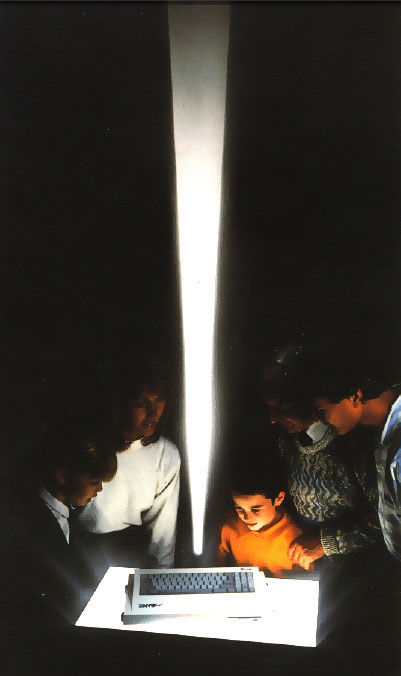


 To every early SAM owner, there are usually two important images related to their first experience. One is a famous black and white digitized image of an astronaut on the moon, and the second is of Tutankhamen's sarcophagus face. Both of these loaded up gradually from the tape as my first experience with the SAM, and I can remember calling my father up from his study to see the astounding results. It was on my small 14” TV, and at the time it was like seeing my computer produce a photo-realistic image of incredible quality. I had jumped from the extremely limited colour possibilities of the Spectrum, to a world of fantastic graphical potential.


