Showing posts with label Computers. Show all posts

Friday, 5 November 2010

(My) History of Computing – Part II: Blue Feet and Astronauts

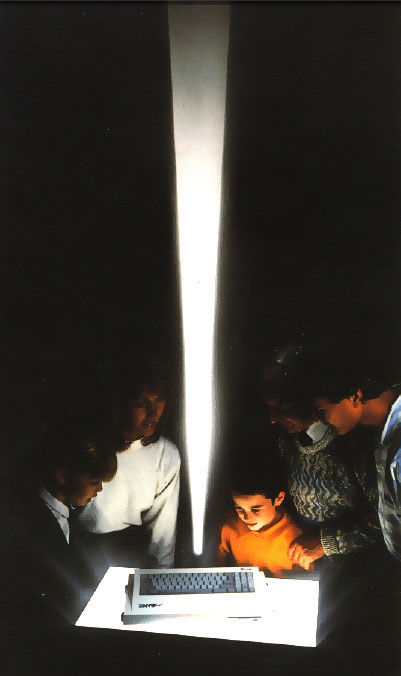
An early SAM Coupé promotional image
Due to money issues, I tended to be one step behind what was popular. I got my 48k Spectrum second hand when the 128k models had become the norm. I got my Spectrum+2 second hand when the Commodore Amiga and Atari ST were gaining momentum. When I spotted a SAM Coupé in a large news agents in Ayr, Scotland, I was very tempted (I think it was a Forbouys, but I couldn't swear to it). Back in those days it was much like W.H.Smith still is today, except those type of shops were also some of the few places you could get computer items back then. No dedicated shops the way we have now (Not that I remember, anyway!).

The SAM was intended to bridge the gap between those who had started computing with machines like the ZX Spectrum (As I had) and those who wanted to upgrade to a more powerful machine, but couldn't afford the likes of the Atari ST or Commodore Amiga which were at the high end of the home computing market. It was the most powerful 8bit computer, built with 'tinkerers' in mind. It had been designed for those who wanted to easily learn programming, as well as those who wanted to go that extra step and explore the creation of new add-on devices and the like.

The SAM Coupé Computer
It's an unusual looking machine, as you can see from the images. It had a large space in front of the keyboard that leant itself rather nicely to being a handy palm rest (something that still has to be bought separately for most PC keyboards), drive bays at the front, and blue rubber feet on either side that, along with its sloping profile, gave rise to its name. No one can say it didn't have a distinctive look.

'SAM' the friendly robot mascot of the
SAM Coupé
That year (1992, if my maths is correct) I was still living in Scotland with my mother, in order to finish my final year of Scottish Standard Grades. I think I was about fifteen, going on sixteen. The rest of the family had moved down south to Yorkshire due to my father's job, and he visited as often as he could. It was just at the end of this period, when we were about to move down to Yorkshire to be with the rest of the family, that I spotted the SAM. I had read about it in the Spectrum magazines at the time, and was curious. My father was with us when I first spotted it, and we got chatting about the possibilities. I had recently gained some inheritance money after the death of my Grandfather, and although I was still incredibly reticent to spend any, the door was open for the possibility. On that first visit, I still couldn't bring myself to buy something of that price (I think it was just under the £200 mark), but I was becoming increasingly eager to move onto a more advanced computer, and the other options were still far too expensive in my eyes.

The SAM Coupé logo
So it was, that with my father's encouragement, and convincing myself that I wasn't spending that much money just to play games, I made the decision. My first brand new computer. I only made the decision just as we were moving, and luckily it was still there when we went for a final visit into Ayr. So although bought in Scotland, I didn't get to boot up my new SAM Coupé till we were in Yorkshire. New home, new computer.

The 1st image I saw on the SAM Coupé
I had also paid that bit extra, and bought the internal disk drive to go with the SAM, but much to my dismay, the DOS (Disk Operating System) disk was nowhere to be found. I was able to contact the manufacturers who soon sent out the disk, but in the meantime, I was able to run the demo tape that came with the machine.

To every early SAM owner, there are usually two important images related to their first experience. One is a famous black and white digitized image of an astronaut on the moon, and the second is of Tutankhamen's sarcophagus face. Both of these loaded up gradually from the tape as my first experience with the SAM, and I can remember calling my father up from his study to see the astounding results. It was on my small 14” TV, and at the time it was like seeing my computer produce a photo-realistic image of incredible quality. I had jumped from the extremely limited colour possibilities of the Spectrum, to a world of fantastic graphical potential.

My 1st digital art
Before even the DOS disk arrived, I used the art package FLASH (that came on tape with the SAM, and was coincidentally programmed by Bo Jangeborg who had created Fairlight), and created a couple of images that I am still quite pleased with, given the limitations at the time (I was still loading and saving to tape, and had no mouse). One was Arnold Schwarzenegger in Terminator 2, and the other was Beauty and the Beast, from the Disney film of the same name.

My 1st digital art
Although I had always been interested in computers, it was from that day I started down the route that would turn it from casual hobby to an eventual career.

In Part III, I'll talk about learning to program, the disk magazine that kept the SAM alive for a long time, creating my own computer games, and lots more...


All work is the © copyright of W.D.Lee and/or the respective companies, individuals or organisations to which the work is related. No infringement is intentional. No reproduction or copying is permitted without express permission.

Tuesday, 12 October 2010

(My) History of Computing – Part I: Turtles to Rubber Keys

A BBC Micro
As a child, my first real exposure to computers was the BBC Micro in school, which is probably true of many people my age who lived and went to school in the UK during the mid-to-late 80s and early 90s. I didn't learn a great deal on it, but I was interested. We had just the one in our primary school, and I got the chance to program in Logo and dabble in BASIC a little. The main thing I can remember is using a Turtle to plot out our Logo commands onto a piece of paper, drawing numerous patterns. It was all very limited, but fun.

An Amstrad PCW 8256/8512
The next step was the Amstrad PCW8256 (See more in Writing and Publishing the 'Rebel Review'). My father bought this machine essentially for creating the local Parish Magazine, although he was also a bit of a gadget fan which I'm sure played a significant part. When he wasn't using it, my older sister Hilary and I were allowed to have fun trying different things. She was learning computing in secondary school while I was still in primary, so she was the most knowledgeable. Occasionally my father's '8000 Plus' magazine (Later renamed 'PCW Plus') would contain 'listings' in the back pages. These were short programs that you could type in to the computer using the PCW's 'Mallard BASIC'. Whenever one popped up that was a game, my sister and I were soon busily typing away, inputting line after line of code onto the PCW's green-only screen. Hours would be spent sifting through the code, sometimes printing it out so we could compare it to the magazine listing, and highlight bits where we'd gone wrong. I also spent a fair amount of time creating graphics using the PCW version of Logo, and printing out the pictures.

Tomahawk on the Amstrad PCW
Eventually we got a few games for the PCW, the main ones of which were Fairlight, Tau Ceti and Tomahawk. Tomahawk was my first exposure to 3D gaming, and also prompted the purchase of a joystick. It was heralded as being incredibly realistic to the physics and mechanics of the real thing, with countless buttons on the keyboard used to control the various aspects of the helicopter. I spent a long time studying the manual and trying all sorts.

Fairlight on the Amstrad PCW
Fairlight was the first isometric 3D game I had ever played, with a wonderful and utterly engrossing fantasy world full of unusual and exciting locations to explore and mysteries to solve. Tau Ceti was essentially a fun shoot-em-up, but again with a wide-ranging world to explore.

My most prominent use of the PCW was for my own magazine, the 'Rebel Review' which you can read about separately (Click here). Eventually my father upgraded the machine with an extra 256k internally, a whopping 1MB ram-pack, a bubble-jet printer and a mouse, with which I was able to enjoy creating early monochrome pixel graphics with some desktop publishing software.

A ZX Spectrum 48k
During this time, I also got a Sinclair ZX Spectrum 48k, the very first computer of my own. Well known for its small size and rubber keyboard. To this day it's still a design classic, in my opinion. Admittedly, I fell into the trap that many did, of using it to play only games. When I needed to write a document or print anything, I still used my father's PCW. One thing the Spectrum did do, was encourage my early tinkering. Once or twice I had problems with something, or a friend's machine went wrong, and I was able to swap chips around on the inside, changing those from a couple of dud machines in to the damaged one and vice-versa, till I could get one working. I even still have a 48k Spectrum that stopped working, but after my experimental repair work functions fully, but only in B&W! Later I moved onto the Spectrum+2, with its 128k memory and built in tape-loader, enabling me to play the newer, larger games with better sound.

Issue 1 of 'Your Sinclair'
No discussion of the ZX Spectrum would be complete, though, without mention of its most successful magazine, Your Sinclair. It was an irreverent glimpse each month into the Spectrum world, full of the latest games, tips, gossip, and outright oddity. They knew the machines flaws and drawbacks, and revelled in the fun of it all with rarely (if ever) a serious outlook. It always came packed with games and demos on the cover tape to keep the readers happy, and it had a personality all of its own that kept it entertaining outside of simply being a magazine for the Spectrum.

Chaos on the ZX Spectrum
I didn't do a great deal other than gaming on either Spectrum, but I do remember programming the +2 BASIC to play Happy Birthday, and write Happy Birthday bouncing around the screen in multiple colours for my father's birthday. I also attempted some extremely simple 3D modelling and game creation with 3D Construction Kit, based around the Freescape engine. Amidst the solo-gaming, I also remember having fun with group games like Chaos, with my mother and sisters, all firing different spells at one another and conjuring magical creatures to attack.

Robocop on the ZX Spectrum
I have enormously fond memories of playing all the old games on the Spectrum, from RoboCop with its monochrome graphics, to two-player ATV Simulator with my friend David on the kitchen table looking at a 6” B&W portable TV. There was a charm to those old games, because the limitations forced their creators to think imaginatively. It was impossible to rely on graphical power and anti-aliased texture mapping to impress. It was the fun, the game-play, that kept people coming back or not. In the current gaming world, this style seems to have had somewhat of a resurgence in the mobile gaming market, with restricted but creative games.

A ZX Spectrum+2 Computer
The ZX Spectrum will always be a major milestone in my computing experience, because it was not only the first machine of my very own, but was at a time when computing was only just taking off. It was still something of a miraculous event, simply to see some animated shapes moving around a screen at the press of a button. They may have been primitive by today's standards, but the Spectrums were the X-Box360, PS3 and Wii of their time, all rolled into one. Not only that, but as others have said before, the Spectrum is responsible for creating a generation of British programming talent that still allows our country to punch well above its weight in the gaming industry. Beware, though... It can't last forever, and the new generations only know how to point, click, tap a joypad or wave a motion control...

In Part II, I'll talk about possibly the greatest computer ever made, the SAM Coupé (no, it's not a car). It wasn't the most powerful, it wasn't the most successful, it wasn't even the most reliable, but it had style, baby... Style and blue feet...

All work is the © copyright of W.D.Lee and/or the respective companies, individuals or organisations to which the work is related. No infringement is intentional. No reproduction or copying is permitted without express permission.

Tuesday, 29 June 2010

Retro Gamer and the SAM Coupé

Invasion II

Many eons ago, as I progressed on the gradual ladder of computer ownership, I owned something known as a SAM Coupé. Regarded as somewhat of a failed cousin to the ZX Spectrum, the SAM Coupé was probably the last and most powerful 8bit computer to hit the market.

It was considerably more powerful than the Spectrum both generally and graphically, and marketed as a logical upgrade for those who still wanted to be able to play most of their Spectrum games, but own something more akin (but cheaper) to the Atari ST and Commodore Amiga, which had become the computer of choice by that time.

For varying reasons it failed to become a success, but managed to maintain a core of dedicated users. I was amongst them, and were it not for the SAM Coupé, I wouldn't be programming and designing educational software today. The ease with which it was possible to learn BASIC on the SAM, and its lack of mainstream game support were the best incentives I could have asked for. Perhaps I'll write something about that in the future...

So why am I suddenly waxing lyrical about this minor(major to me) stepping stone in home-computing history? I recently discovered there was an article in issue 74 (Feb 2010) of Retro Gamer magazine (Available at most major magazine sales locations) about the SAM Coupé. A retrospective article discussing its history. I'm a casual buyer, but I'd missed that issue first time around and decided to order a back copy out of curiosity. Little did I know, it contained a small and brief mention of my very own game, Invasion II, which was published a few years back on the cover-disk of a small magazine that is still published for SAM Coupé enthusiasts (SAM Revival).

A surge of pride ran through me, as I saw a screen shot from the game as one of the machine's top-ten, alongside a small description and my name in print (See above). Okay, it's a small thing, but it's enormous fun to still find one of my creations being mentioned and publicised after all this time. Although the game was never published until 2004, I wrote it way back in 1996.

The game was rather nicely mentioned back in issue 9 of Retro Gamer as well, but it's nice to see a second mention after all this time, especially now my name is attached. They mention that I was clearly influenced by games like Impossible Mission and Flashback. Oddly enough, I've never played Impossible Mission, and I never played Flashback till after Invasion II. Though on the SAM Coupé disk-magazine FRED, someone once created a few screen captures of Flashback, to show what it could look like on the SAM. I remember thinking “I can do my own version of that!” Probably the main influence I had was the SAM version of Prince of Persia, which was one of the few SAM games to be released with quite stunning animation. I wanted to do the same, but in a gun-toting science fiction game. The rest, as they say, is history...

All work is the © copyright of W.D.Lee and/or the respective companies, individuals or organisations to which the work is related. No infringement is intentional. No reproduction or copying is permitted without express permission.

Wednesday, 16 June 2010

Writing and Publishing the 'Rebel Review'

My first really concerted effort at producing my own written works, was called the 'Rebel Review'. Since childhood and to this day, I have been a fan of Star Wars. How much of a fan depends entirely on your perception of such things. Some people would consider me an over-the-top fan with a large collection of Star Wars books, a fair sized collection of the original toys from childhood (ebay tempts, but hasn't won yet!), numerous collectible items and various copies of the movies from different releases over the years. Then again, a real Star Wars fan would probably consider me a mid-level enthusiast. I'm too interested in plenty of other things in general, to be a true fanatic (I think!).

Regardless, I was enough of a Star Wars fan in my teens that when I decided to make my own magazine, I chose to make it predominantly Star Wars related with short stories and various movie and book reviews. I'm not sure, but I think one of my sisters suggested the title. In honour of the Rebel Alliance (The good guys, for those of you who have never lived on this planet), it ended up being called 'The Rebel Review'.

What prompted me to this creation? Well, it was an endeavour that combined many of my favourite things.
  • Star Wars and Science Fiction? Check
  • Movies? Check
  • Books? Check
  • Artwork? Check
  • Story and other writing? Check
  • Excuse to use the computer and photocopier? Check
My father produced the local parish magazine on a monthly basis, using the combination of a rental-purchase photocopier and his new Amstrad PCW8256 computer with 9-pin dot-matrix printer. It was my first true exposure to computers, outside of a friend's ZX Spectrum and the limited BBC micros at school. To this day, there's still something strangely hypnotic and unusual about the PCW. The guts of the machine were inside the same casing as the monitor, which itself was green-screen only. I could easily wax lyrical about the hours spent programming games in BASIC from listings in the magazine, creating primitive graphics in LOGO, the unusual 3” disks, or playing Fairlight and Tomahawk into the early hours, only to come away with square eyes and a strange sense of detachment from reality... but those are for another time. For now, its miracle was the ability to write and save files using the LocoScript word processor, and print them.

So it was, that using word processing software that would be considered less-than-primitive now, I learnt to type and write on a computer. I was fascinated with what my dad was able to do on that machine, and I wanted to produce something of my own.

The first issue was put together in 1990, after the release of 'Gremlins 2'. I would've been about fourteen. I continued producing them until the 7th and final issue was released in 1995. It had huge print runs, of perhaps 10, maybe even 20 copies, sold to friends and relatives with plenty of encouragement and praise from my mother. I wrote short stories, created word-searches, quizzes and games, wrote film and book reviews, and gave my thoughts on the latest movie news. I often drew pictures for the covers and the stories. By the final few issues I was even using an art package and mouse on my Dad's PCW to produce primitive black and white computer graphics.

It was all enormous fun, most of which was had in piecing together the various items for photocopying. For example, the first issue sported an image of Gizmo from 'Gremlins 2' on the front cover along with the magazine title and a couple of small accompanying images (See the start of the article). How did I produce that? I had one piece of paper on which I glued two photocopied images from my favourite movie magazine (the sadly extinct 'Starburst'), and drew a large portrait of Gizmo in pencil. On a second piece of paper, I printed the title and a couple of other bits of text. I would then photocopy the title page, then run the same used pieces of paper through the copier again, this time photocopying the Gizmo images. Voila! A title page combing the two.

Gradually my expertise grew. Numerous tiny bits of Blu-Tack or Pritt Stick glue kept images, titles and lines of text onto pieces of A4 paper, which were then copied to produce inventively laid out pages. Finally, they were all stapled together to create multiple copies of each issue. The sense of accomplishment at picking up and flicking through a 'magazine' created by myself was fantastic. Sure, looking back on them now it's easy to see them as naïve and primitive, but it's all part of the knowledge and experience that has taken me to where I am today (Or at least given me some fun childhood memories).

In retrospect, it also provided an unusual form of bonding between my father and I. It was at once a solitary process, creating the Rebel Review, whilst also being something we could share. I was using all of my Dad's equipment, from the PCW and photocopier, to his stapler and paper guillotine. We enjoyed our mutual fascination and enjoyment at using the computer, and he was able to help me when I required it. For a few days or more while my life was suddenly consumed with this creative project, I was ever-present in his study, taking up space and no doubt getting in the way while I made it. When I think back, he must have been incredibly patient!

What did I learn? Plenty, no doubt, but the most important factor is the memories. Childhood enthusiasm and dreams that came to life and became miraculously real, with the involvement of family and friends.

In a way that even photos cannot manage, I can pick up one of those old issues with their now-yellowing pages, and a host of memories and emotions come flooding back. It conjures up those times when I felt  accomplishment (simple and minor as it was) combined with naïve optimism, and it was all shared with loved ones and friends to create something that never fails to bring a smile.