Showing posts with label General Musings. Show all posts

Wednesday, 6 April 2011

A Question of Art

Art or Art?
(Tracey Emin / Leonardo da Vinci)
Recently, I've been looking at a lot of differing forms of art (For the sake of argument, I'm referring to the general visual arts from here on). When you look at art, you form opinions, it is impossible not to. The drawback of forming such opinions, is that you can then find yourself questioning what is and isn't art. Of course, in its purest form the question is meaningless. Art is defined in whatever way you wish, whether it's a pile of bricks and a dirty bed to the Sistine Chapel and the Mona Lisa. All can be argued equally.

Then again, without some opinion of what is and isn't art, does the word 'art' itself become meaningless? Surely we must have an opinion of what art is, in order to appreciate it as art? Perhaps we should start by looking at the publicly held definitions. Here is the dictionary.com definition of the word 'art'.

Art
–noun
1 - the quality, production, expression, or realm, according to aesthetic principles, of what is beautiful, appealing, or of more than ordinary significance.
2 - the class of objects subject to aesthetic criteria; works of art collectively, as paintings, sculptures, or drawings: a museum of art; an art collection.
3 - a field, genre, or category of art: Dance is an art.
4 - the fine arts collectively, often excluding architecture: art and architecture.
5 - any field using the skills or techniques of art: advertising art;industrial art.
6 - (in printed matter) illustrative or decorative material: Is there any art with the copy for this story?
7 - the principles or methods governing any craft or branch of learning: the art of baking; the art of selling.
8 - the craft or trade using these principles or methods.
9 - skill in conducting any human activity: a master at the art of conversation.
10 - a branch of learning or university study, especially one of the fine arts or the humanities, as music, philosophy, or literature.
11 - arts,
     11a -used with a singular verb ) the humanities: a college of arts and sciences.
     11b -used with a plural verb ) liberal arts.
12 - skilled workmanship, execution, or agency, as distinguished from nature.
13 - trickery; cunning: glib and devious art.
14 - studied action; artificiality in behavior.
15 - an artifice or artful device: the innumerable arts and wiles of politics.
16 - Archaic. science, learning, or scholarship.

Art or Art?
(Neal Adams / Pablo Picasso)
You only need to look at the number of definitions to realise that it is nearly impossible to pin down the meaning or meanings of the word. Most words, even the broadest, can usually be pinned down within some confining limitations, however broad. Art, on the other hand, is all-encompassing because it is entirely dependent on individual perception and context.

If I wrote or printed this article on a canvas and then placed it in a gallery, it would be art. Or at least, it would be for those who chose to see it that way. In fact, even in its current form it could be described as art, if I so wish. Some might argue that only items painted with oils on canvas are art. Another might claim everything is art if you look at it from the correct perspective. Yet another may say that it must be about something, say something meaningful, to be art. Who is right, and who is wrong? The truth is, they are all right for the individual and nobody else.

Of course this creates frustrations. One artist's meaningful work is another artist's meaningless rubbish and vice versa. The human tendency to pigeon-hole, to define, to narrow perspective and quantify, means that even the individual with the broadest perspective, will see some items as 'superior' or more 'meaningful' than others and therefore more artistic, depending on their personal preferences (even if they consciously believe themselves to be impartial) .

Art or Art?
(Piet Mondrian / Drew Struzan)
Let's ask another question, then. What about 'meaning'? Art is surely meant to speak to people in one way or another, whether it is purely for aesthetic pleasure, to tell a story, or to contain some comment on a chosen topic. If we believe this, then here is my question. Should the meaning of the work be clear? If we look at a piece of art, and the meaning is not obvious or at least generally understandable after some time, has the art failed?

Undoubtedly, we've all looked at some artwork and wondered what the hell it's about; If it has any meaning whatsoever. Then again, we can also argue about the level at which said meaning should become clear. Should art be simplistic, so that its meanings are obvious to even the most visually illiterate? What if a piece of work is clear to those who have an understanding of the visual arts, but not others? Perhaps the only argument we can make, is that for a piece of art on public display that is intended to convey meaning to at least some viewers (however limited that audience may be), if it is so ambiguous that it is only meaningful to the artist themselves, then it has failed. Of course, this statement itself can be circumvented if the artist states that the viewer is meant to come away with whatever meaning they choose, and not be limited to that of the artist during its creation.

Art or Art?
(Vincent van Gogh / H. R. Giger)
The only conclusion we can reach, is that art, like beauty, is in the eye of the beholder. If I wanted to sound deep and pretentious, I could say that art exists in a quantum state. It is Schrödinger's cat. All things are simultaneously art and not art, until observed. Unlike Quantum Physics, once observed it does not become a single specific state for everyone. It can still exist in a different state for each individual observer.

So the next time you look at something defined publicly as a piece of artwork, don't be afraid to see it the way you wish. Your opinion is every bit as valid as the next, regardless of your 'knowledge' or 'experience' in relation to the piece. On the other hand, remember that even completely opposing views, are every bit as legitimate for those who hold them.

All work is the © copyright of W.D.Lee and/or the respective companies, individuals or organisations to which the work is related. No infringement is intentional. No reproduction or copying is permitted without express permission.

Monday, 21 February 2011

Hypothetical...

I'm reading a book at the moment, which I'll talk about later (and can't mention yet, without giving away the point). However, it raises some very interesting issues, which made me curious about public perceptions. So, I want to pose you a hypothetical question...

Case One
(First, let me just state, that I have not aimed for or pretended any authenticity in the courtroom examples below. They're merely used for the illustration of a specific point, so please forgive any 'legal' inaccuracies.)
Imagine you're in court on jury duty. Not a show-boating exciting event, like the court cases in the films or on TV. No, this is in one of those standard everyday courts that you read about in the Newspapers.

The first case arrives. It's a strange one, because the prosecution doesn't want to accuse anybody of a terrible crime. They don't want to sue a faceless corporation for millions. Very humbly, all they ask, is to show that they have enough evidence for a matter to be taken seriously and investigated further.

You try and hide a yawn from where you sit, wondering if the whole day is going to be so boring. Then things take an interesting turn, as the prosecution outline their case. The issue they want taken seriously and investigated, is the existence of a mystery weapon and for the court to accept that an event revealing it, actually happened as witnessed.

So far so good, you think. But the defence argues that the case has no merit. Where is the prosecution's proof?

The prosecution then outlines the event. It occurred in a shopping centre car-park. A man ran into the crowded area, waving a gun around and firing it into the sky madly, before escaping. His motivations were unknown. The individual's possible reckless endangerment of lives, and use of a mystery weapon to intimidate and frighten a large number of civilians, drew the attention of several police officers who clearly saw and chased the culprit, without capturing him.

Straight forward, you think, as you wonder why the Defence rolls his eyes.

The Prosecution then proceeds to give his evidence to a distracted and barely listening judge.
Exhibit a) CCTV footage that proves the perpetrator was at the scene of the crime and acting suspiciously, even though it does not show the weapon.
Exhibit b) Photographs. Ten or more witnesses of the event managed to snap admittedly blurred photographs on their mobile phones.
Exhibit c) Video Footage. Two of the witnesses had their phones set to record video, and shot footage of the event in low quality. The perpetrator was waving his weapon around a lot, sometimes moving behind cars and people, showing it was clearly in his hands, but never sharply enough to see in great detail. It was clear enough, however, to establish that it was unusual and definitely not of normal design.

Witnesses? The Prosecution provides sworn statements from twenty to thirty witnesses, including those who took photographs and video. They then provide a further two highly reputable witnesses. On duty policemen who chased the offender from the scene, but were unable to catch him. They all clearly saw the weapon the man was holding. They also testify that he fired the weapon into the air, firing some kind of unusual rounds that didn't sound like normal gunfire. However, the weapon was clearly functional and not a toy or replica.

Then the prosecution provides expert testimony from several weapon's experts, who swear they have heard such weapons exist, and some have even seen them.

The Prosecution rests his case, giving the Defence a chance to speak. The Defence promptly pleads with amusement to the weary judge, stating that all of the evidence and witness testimony proves nothing. There is no weapon physically on display here in the court. It's just a load of silly nonsense, where the Prosecution lacks even a clear photograph of the weapon.

The judge agrees with a sigh at his wasted time, and throws the case out of court.

You go home, wondering what happened. When you relax in front of your TV with a drink, you turn on the news to see a report on the case. After a long piece about a drunken pop-star, they dedicate little over a minute to reporting the court case. The reporter laughs and jokes about toy guns and Star Trek phasers, implying it's a cheery piece of amusing news to round off the day, before moving on to the sport's scores.

The First Question
Before you read any further, I want you to ask yourself. Do you think the case should have at least been given credence, and investigated further? How much proof do you think should be required before something is taken seriously?

Now, read a duplicate of the case above, with a slightly different subject matter. Except in this case, while the example may be hypothetical, similar real-world events of this nature have repeatedly occurred around the world for decades (perhaps much longer), with similar levels of evidence (Though of course without representation in the courts).

Case Two
Imagine you're in court on jury duty. Not a show-boating exciting event, like the court cases in the films or on TV. No, this is in one of those standard everyday courts that you read about in the Newspapers.

The first case arrives. It's a strange one, because the prosecution doesn't want to accuse anybody of a terrible crime. They don't want to sue a faceless corporation for millions. Very humbly, all they ask, is to show that they have enough evidence for a matter to be taken seriously and investigated further.

You try and hide a yawn from where you sit, wondering if the whole day is going to be so boring. Then things take an interesting turn, as the prosecution outline their case. The issue they want taken seriously and investigated, is the existence of a mystery flying object and for the court to accept that an event revealing it, actually happened as witnessed.

So far so good, you think. But the defence argues that the case has no merit. Where is the prosecution's proof?

The prosecution then outlines the event. It occurred in a shopping centre car-park near an airport. An unidentified flying object hovered for several minutes over the crowded area, moving around quickly and erratically, before dashing into the sky, and escaping. Its motivations were unknown. The vehicle's possible reckless endangerment of lives in heavily trafficked airspace, and use of a mystery propulsion system witnessed by a large number of civilians, drew the attention of several nearby airforce pilots on routine manoeuvres, who clearly saw and chased the mystery object, without capturing it.

Straight forward, you think, as you wonder why the Defence rolls his eyes.

The Prosecution then proceeds to give his evidence to a distracted and barely listening judge.
Exhibit a) Radar records. These prove the object was at the scene and acting suspiciously, even though it does not show further details.
Exhibit b) Photographs. Ten or more witnesses of the event managed to snap admittedly blurred photographs on their mobile phones.
Exhibit c) Video Footage. Two of the witnesses had their phones set to record video, and shot footage of the event in low quality. The object was moving around a lot, sometimes moving behind buildings and clouds, showing it was clearly there and real, but never sharply enough to see in great detail. It was clear enough, however, to establish that it was unusual and definitely not of normal design.

Witnesses? The Prosecution provides sworn statements from twenty to thirty witnesses, including those who took photographs and video. They then provide a further two highly reputable witnesses. On duty airforce pilots who chased the object from the scene, but were unable to catch it. They all clearly saw the mystery object. They also testify that it flew in an unusual way that didn't match any normal aircraft. However, the unidentified flying object was clearly functional and not a toy, replica or normal aircraft of conventional design.

Then the prosecution provides expert testimony from several aviation experts, who swear they have heard such vehicles exist, and some have even seen them.

The Prosecution rests his case, giving the Defence a chance to speak. The Defence promptly pleads with amusement to the weary judge, stating that all of the evidence and witness testimony proves nothing. There is no 'UFO' physically on display here in the court. It's just a load of silly nonsense, where the Prosecution lacks even a clear photograph of the object.

The judge agrees with a sigh at his wasted time, and throws the case out of court.

You go home, wondering what happened. When you relax in front of your TV with a drink, you turn on the news to see a report on the case. After a long piece about a drunken pop-star, they dedicate little over a minute to reporting the court case. The reporter laughs and jokes about mars and little green men, implying it's a cheery piece of amusing news to round off the day, before moving on to the sport's scores.

Why the Hypothetical Scenarios?
I'm currently reading "A.D. - After Disclosure", a book about the possible repercussions to our world and society, in the event that U.F.O.s are revealed to the public at large, through an event of enough global magnitude, that governments no longer have the ability or credibility to hide facts, and must instead reveal them (Assuming you believe in U.F.O.s, and their possible associated cover-up).

In reading the book, it made me think that perhaps the greatest obstacle to any such 'truth' (I'm reasonably convinced, but I won't presume you are) being revealed, is the utter ridicule and condescension in which it is held. When you look at the evidence of U.F.O.s, and the credibility-stretching 'proofs' from the skeptics (both of which are topics for other books and discussions, so I won't go into them here), you realise that even if they turned out to be of the most mundane and natural source, they do not deserve to be viewed with such casual contempt and dismissal.

I'm not talking about unquestioning belief, but simply that the subject deserves credible investigation and consideration by authorities and the media. Records show that in the past, such as World War II, they have been taken very seriously. However, they are now viewed with not only condescension, but outright ridicule and dismissal.

Even if the most convincing cases all turned out to be top-secret human aircraft projects, it still implies that their dismissal by the public and media is at best, a case of utterly missing and ignoring events of considerable significance, purely because of their perceived nature and associated levity.

The Final Question
So to repeat, ask yourself, do you think the case should have at least been given credence, and the chance to investigate further? Or has your opinion changed, in light of the commonly accepted public perceptions and dismissal?

Thanks for certain stock images:
silver-stock.deviantart.com
vera-stock.deviantart.com
eteria-stockphoto.deviantart.com
lunanyxstock.deviantart.com
fantasystock.deviantart.com

All work is the © copyright of W.D.Lee and/or the respective companies, individuals or organisations to which the work is related. No infringement is intentional. No reproduction or copying is permitted without express permission.

Monday, 26 July 2010

They Live, We Sleep

(Not So) Subliminal Mind Control is Alive and Well in the UK.

We all know the point of advertising is to consciously and/or subconsciously guide us toward certain choices. In most cases, though, we may consciously see it, but our ultimate reactions to it are probably more subconscious. For example, seeing a fun advert for a chocolate bar, and consciously thinking “Hmmm... that looks nice”, then several hours later buying a chocolate bar (perhaps even a specific brand), that you may not have otherwise bothered with. The modern world is absolutely full of such examples. We are so saturated by advertising, branding and marketing in every aspect of our lives, that we have become oblivious to it. For the advertisers, I believe this has become both a disadvantage and a boon.

For a truly successful recent example, how many children do you think now have toy Meerkats, due to a certain price comparison website's ad campaign? However, then consider how many other adverts are shown, that don't have the same impact. How many of those do you remember? It's more difficult for advertisers to slip those messages into our conscious minds now, in preference over others. On the other hand, because we are so saturated with them, we no longer take much notice of the majority we see, so they are undoubtedly embedded rather snugly in our subconscious, ready to give a little push when we see something they're associated with.

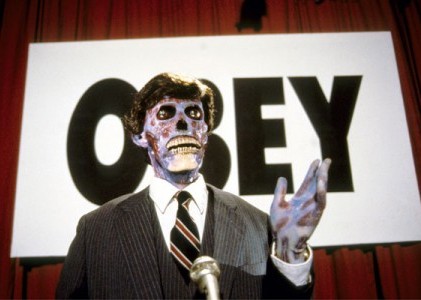
So why am I discussing this? Well, the other day I came face-to-face with a prime example of the pessimistic science fiction world becoming reality. In the 1988 film They Live, the main character discovers that with the aid of some specially coated 'sunglasses', he can see the world for what it truly is. Humanity is living in an induced state of consciousness that resembles sleep, in which our alien masters wander around normally, but we see them as other humans. More importantly, for the sake of this discussion anyway, the sunglasses also reveal the subliminal messages used to control our behaviour. Every magazine, every advert, every billboard is covered simply in large black lettering against a white background, upon which are words such as 'Obey', 'Consume', 'Do Not Question Authority', 'Submit', 'Marry and Reproduce', 'Watch TV', etc.. One of the most amusing and cutting moments is when Nada (The lead character, his name symbolising the every-man and/or nobody) sees a wad of money in a shopkeeper's hand. Across each note is simply the words 'This is Your God'.* (See below)

The film is a comment on Reagan era economics, societal and personal greed and selfishness, the suppression of the masses for the power of the elite, the way in which the underclass can spend so much time fighting amongst themselves that they allow themselves to be exploited and miss what is quite literally before them... amongst those and other issues, the film is also a comment on how we sleepwalk through our lives, oblivious to the controlling and suggestive wording and imagery that surrounds us.

The other day, I discovered what it might have felt like for Nada, when he first saw those oversized statements of control. Walking into a shopping centre, I was greeted by a plain white, unadorned wall upon which was written a single bold word, in the plainest text, all in black. There was no indication of brand affiliation. This was not for a specific shop or product. This was for general observation without context, apart from the location itself. Unlike the images from the film They Live, the image on the left wasn't a matte painting effect or a prop. It was real. In giant letters, was written the word 'LUST'. Of course, it is clear what its purpose must be. Lust is associated with passion, desire, need, want. All the key words that imply we must have something. It cannot be coincidence that it is there for all to see upon walking into a shopping centre, the Mecca of western consumption.

It is so large and prominent, that of course many will notice it (though it was incredibly disturbing to see how many walked by without even a glance of acknowledgement). For those who didn't 'see' it, the sign will of course help suggest to them later on, that they must buy items that they 'need' in the shops. For those who do notice it, well, perhaps we are all the worse off. For we know its influence and purpose, but we soon forget while shopping, and are perhaps still likely to 'buy' and 'consume' all the more, because of a word that suggests those desires in the back of our minds...

How much of our lives are controlled? How much free will do we truly have? You really have to wonder, sometimes...

* Side Note 'This is Your God' (See 3rd paragraph)
On a side note, it does bring up an interesting point. America is well known for being a society of consumption and a the thirst for money (I'm not saying the UK or other places are any different or better, America just happens to be the poster child for such culture). It has the statement on its dollar bill: 'In God We Trust'. Of course consciously we know this is simply a reference to Christianity and the Christian God, which was and is the predominant religion of those who founded the country. But it begs the question, what subliminal influence has this had on the generations of Americans who use the dollar bill every day? The statement on the bill is not surrounded by imagery of particularly Christian context. It is not next to an image of Christ, or the cross. It is simply a statement on the bill, which is the only context. Does it thus subliminally imply that the bill itself is the God in which to place one's trust? You can't help but wonder if this has had any effect on American economics and society over the decades. Anyway, I digress...

All work is the © copyright of W.D.Lee and/or the respective companies, individuals or organisations to which the work is related. No infringement is intentional. No reproduction or copying is permitted without express permission.